These days, electronic gadgets have become a part of our daily lives in many ways; we use cell phones, computer systems, refrigerators, washing machines, air-conditioners, and other electrical gadgets in our daily routines. Almost all such electrical equipment is fitted with a Printed Circuit Board (PCB) that manages the electrical activity of the device. If there is any problem with a circuit board, the device will fail to operate despite the fact that the remaining parts of the machine may be in perfect condition.
This is when skills related to PCB repairs could come in handy. One could gain valuable experience in electronics by learning about damaged components, electrical connections, short circuits, and faulty tracks.
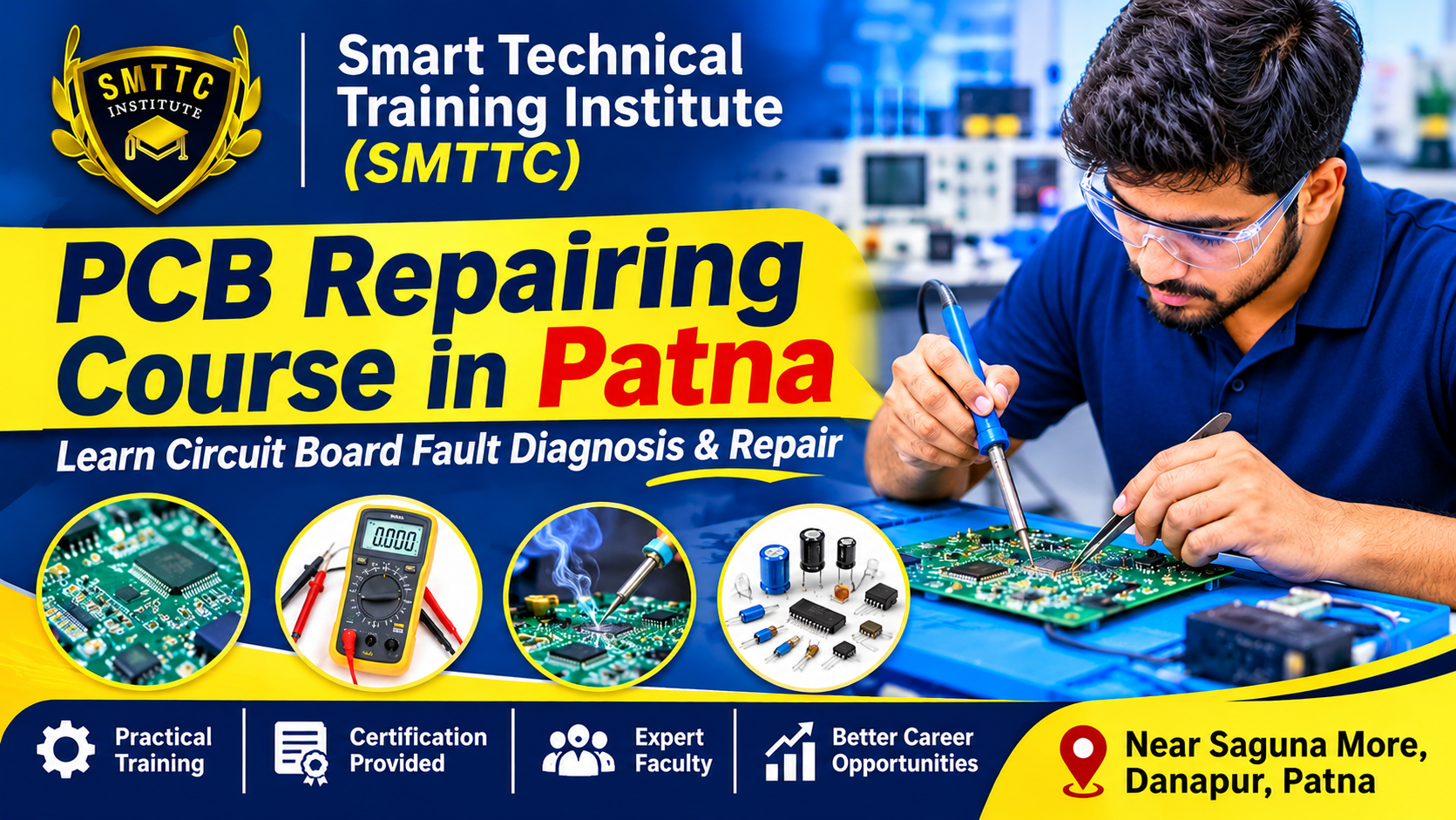
For those who wish to learn more about electronics services, a PCB Repairing Course in Patna could prove helpful.
What Is a PCB and How Does It Work?
The abbreviation PCB means Printed Circuit Board. It refers to a board that connects and supports different electronic components using conductive pathways made of copper.
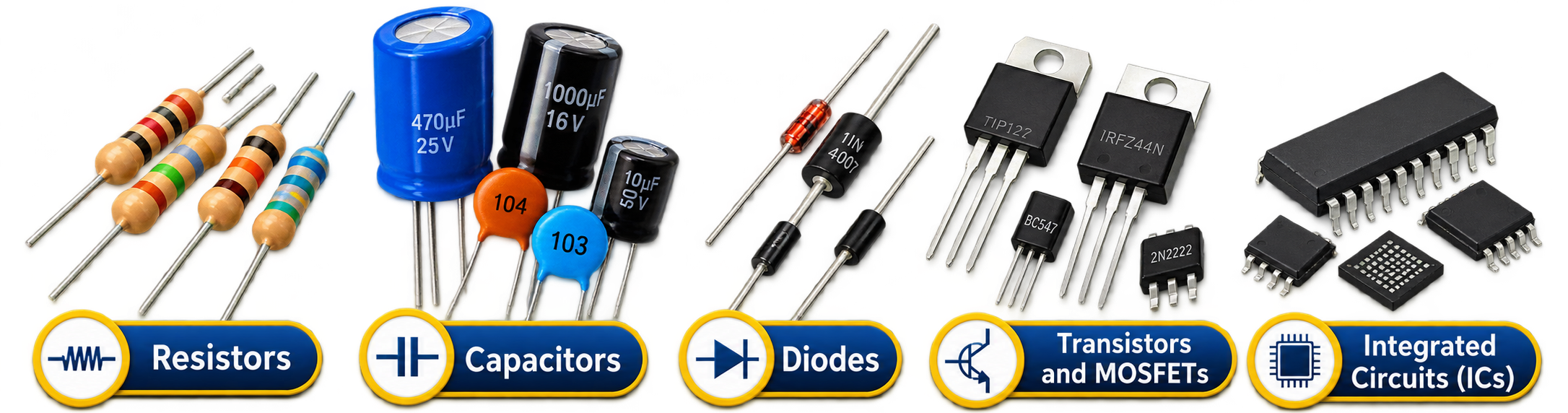
Some of the components contained in a PCB include resistors, capacitors, diodes, transistors, ICs, and connectors among others.
For instance, once you turn an electronic device on, it is the PCB of the device that controls various operations in it.
Main Components Found on a PCB
1. Resistors
Resistors control the flow of electric current in a circuit. They are commonly used to regulate voltage and protect sensitive components.
2. Capacitors
Capacitors store and release electrical energy. They are frequently used for filtering, voltage smoothing and timing functions.
3. Diodes
Diodes allow current to flow primarily in one direction. They are commonly found in rectifier and protection circuits.
4. Transistors and MOSFETs
These components are used for switching and controlling electrical signals. MOSFETs are especially common in power supply and electronic control circuits.
5. Integrated Circuits (ICs)
ICs contain multiple electronic components within a single package and perform specific functions such as control, processing and signal management.
Different Types of PCBs
-
Single-layer PCB: Contains conductive copper pathways on one side of the board.
-
Double-layer PCB: Contains conductive pathways on both sides, connected through suitable vias.
-
Multilayer PCB: Contains multiple conductive layers used in more complex electronic circuits.
Understanding these PCB types helps learners recognise different circuit board designs before starting repair work.
Common PCB Problems You Should Know
Circuit boards may suffer from various types of failures as a result of excessive heat, electricity, moisture, physical harm, aging, or bad solder joints.
Knowledge of PCB failures is crucial when studying circuit board troubleshooting.
1. PCB Short Circuit
A short circuit occurs when an unintended low-resistance connection develops between points that should not be directly connected. It can cause excessive current flow, heating or device malfunction.
2. Open Circuit or Broken Tracks
Copper tracks carry electrical connections between components. If a track becomes damaged or disconnected, the circuit may stop functioning correctly.
3. Burnt Electronic Components
Excessive heat, overvoltage or electrical stress can damage components such as resistors, capacitors and MOSFETs. Burn marks or visible cracks may indicate a possible fault.
4. Loose or Damaged Solder Joints
Poor solder connections can interrupt electrical contact. These problems may cause intermittent operation, unstable connections or complete circuit failure.
5. Faulty Capacitors
A damaged capacitor may affect voltage filtering, power stability or circuit performance. Bulging, leakage and abnormal electrical readings can help identify possible capacitor problems.
6. Diode and MOSFET Failure
Diodes and MOSFETs are commonly used in power and switching circuits. If they fail, the board may experience power-related problems or incorrect circuit operation.
7. Corrosion and Moisture Damage
Water or moisture exposure can cause corrosion on PCB tracks and component connections. If not identified early, corrosion may lead to damaged pathways and electrical faults.
Recognising these problems is the first step towards developing reliable PCB repair skills.
Tools Used for PCB Repairing
A PCB technician needs suitable tools to inspect circuit boards, test components and perform repair work. Learning how to use these tools correctly is an important part of practical electronics training.
|
Tool |
Main Purpose |
|
Digital Multimeter |
Measures voltage, resistance and continuity |
|
Soldering Iron |
Joins or removes electronic components |
|
Hot Air Rework Station |
Removes and replaces suitable SMD components |
|
DC Power Supply |
Provides controlled power for testing |
|
PCB Holder |
Keeps the circuit board stable during repair |
|
Magnifying Glass or Microscope |
Helps inspect small components and solder joints |
|
Tweezers |
Handles small electronic components |
|
Flux and Solder Wire |
Supports proper soldering work |
Why Is a Digital Multimeter Important?
A multimeter is a widely used instrument when diagnosing PCB problems. A multimeter assists technicians in checking continuity, measuring voltage and resistance, and testing some electronic parts.
For instance, in case the circuit board is not powered, the technician can use the multimeter to check the power connection and detect where the power source is cut off.
At the same time, a multimeter can assist in detecting breaks in tracks and connection losses.
How to Diagnose PCB Faults Step by Step

PCB repair should follow a systematic troubleshooting process. Instead of replacing components immediately, technicians first identify the symptoms and examine the circuit to understand the possible cause.
Step 1: Perform a Visual Inspection
Start by examining the circuit board carefully. Look for burnt areas, broken tracks, damaged components, loose connectors, corrosion and cracked solder joints.
A visual inspection can sometimes reveal obvious problems before electrical testing begins.
Step 2: Identify the Problem Area
Understand the device's reported problem and identify the relevant section of the circuit board.
For example, if a device is not powering on, the power input and supply sections may require inspection. However, the fault should be confirmed through testing rather than assumptions.
Step 3: Perform Continuity Testing
Use a digital multimeter in continuity mode to check electrical connections between appropriate points.
This method can help identify broken copper tracks, disconnected connections and certain open-circuit faults.
Step 4: Check for Short Circuits
Inspect relevant power rails and ground connections using appropriate testing procedures. Unexpected low-resistance readings may indicate a possible short circuit.
The technician should interpret readings according to the circuit design because some normal circuit paths can also show low resistance.
Step 5: Test Electronic Components
Examine suspected resistors, capacitors, diodes and MOSFETs using suitable testing methods.
Component readings should be compared with their specifications or known circuit behaviour. Some components may need to be isolated from the circuit for accurate testing.
Step 6: Perform the Required Repair
After identifying the faulty area, the technician can decide whether the component needs replacement, a solder joint needs correction or a damaged PCB track requires repair.
Proper soldering techniques and suitable replacement components are important for reliable results.
Step 7: Verify the Repair
Once you have finished making the fix, go through the solder joints to find any unwanted bridges or faults that may be present. Conduct tests on the circuit board using an appropriate method to verify if the problem is sorted out.
Safety tip: Repairing a circuit board can be dangerous because of high voltages and charged capacitors. Disconnection of power is essential before working on the board. Beginners must conduct their practicals under proper supervision.
What Skills Can You Learn in a PCB Repairing Course?
A structured PCB Repair Training programme can help beginners understand the relationship between electronic components, circuit connections and common board-level faults.
Some important learning areas include:
-
Identification of common electronic components
-
Understanding PCB layouts and circuit diagrams
-
Basic electronics and electrical concepts
-
Digital multimeter operation
-
Voltage, resistance and continuity testing
-
Short-circuit and open-circuit identification
-
Basic diode, resistor and capacitor testing
-
MOSFET and transistor testing
-
Soldering and desoldering techniques
-
SMD component identification and handling
-
PCB track inspection and basic repair
-
Circuit board fault diagnosis
-
Safe testing and troubleshooting procedures
These skills help learners develop a practical foundation for electronics repair and servicing.
Practical PCB Repair Training for Beginners
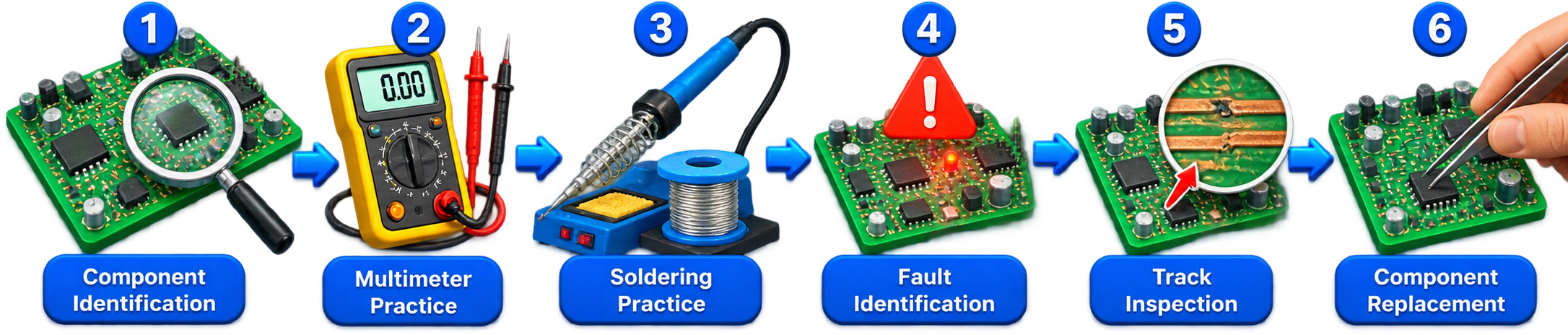
Reading about electronic components is useful, but PCB repairing is a skill that requires regular hands-on practice.
During practical learning, beginners should become familiar with actual circuit boards, different component types and common electrical testing methods.
Some useful practical activities include:
Component Identification: Recognising resistors, capacitors, diodes, transistors, ICs and other PCB components.
Multimeter Practice: Checking continuity, resistance and voltage at suitable testing points.
Soldering Practice: Learning how to create proper solder joints and remove components without damaging the board.
Fault Identification: Examining faulty circuit boards and understanding possible reasons for their malfunction.
Track Inspection: Identifying damaged copper pathways and learning suitable repair techniques.
Component Replacement: Practising the safe removal and replacement of suitable faulty components.
Practical training helps learners connect theoretical knowledge with actual repair situations and gradually improve their troubleshooting confidence.
Career Opportunities After Learning PCB Repairing
PCB repairing knowledge can be useful in different areas of electronics servicing. As electronic devices contain circuit boards, technicians with suitable troubleshooting skills may explore different technical work opportunities.
Some possible career options include:
1. PCB Repair Technician
Work on diagnosing circuit board problems, testing components and performing suitable board-level repairs.
2. Electronics Repair Technician
Assist with troubleshooting and repairing electronic devices and equipment.
3. Electronics Service Centre Technician
Work in service centres that handle electronic equipment inspection, servicing and repair.
4. Repair Workshop Professional
Gain experience in a repair workshop and work on different types of circuit board problems.
5. Self-Employment
After accumulating enough practical skills, one can decide to start their own small business of repairing electronic items. The kind of work that one will be able to do depends on practical skills, experience, specialisation, and knowledge about various electronic systems. Taking up a course is just the first step; further practice is needed.
Where Can You Learn PCB Repairing in Patna and Nearby Areas?
Those who are seeking PCB Repairing Course in Patna can look into technical training courses offered in the city. Opting for institutes which offer hands-on learning can help newbies learn about circuit board testing and identifying faults in the board easily.
One such technical training institute located near Hi-Tech Hospital, Saguna More, Danapur, Patna is Smart Technical Training Institute (SMTTC).
The location of this training institute can be taken into account by those coming to Patna from various locations in the city like:
Danapur and Saguna More
Khagaul and Phulwari Sharif
Bailey Road and Patliputra
Patna City and Fatuha
Besides learners coming from other cities and nearby villages, those coming from other locations like:
Bihta and Maner
Naubatpur and Punpun
Parsa and other neighboring areas
Hajipur and Sonpur
Muzaffarpur and other neighboring locations can take into consideration training facilities offered by SMTTC.
For those living outside the Patna city, making some preliminary arrangements regarding course schedule, travel and accommodation prior to joining SMTTC can help.
Those who are either new to electronics or wish to improve their electronic servicing skills can find PCB repair techniques helpful.
Why Choose SMTTC Institute for PCB Repairing Training?
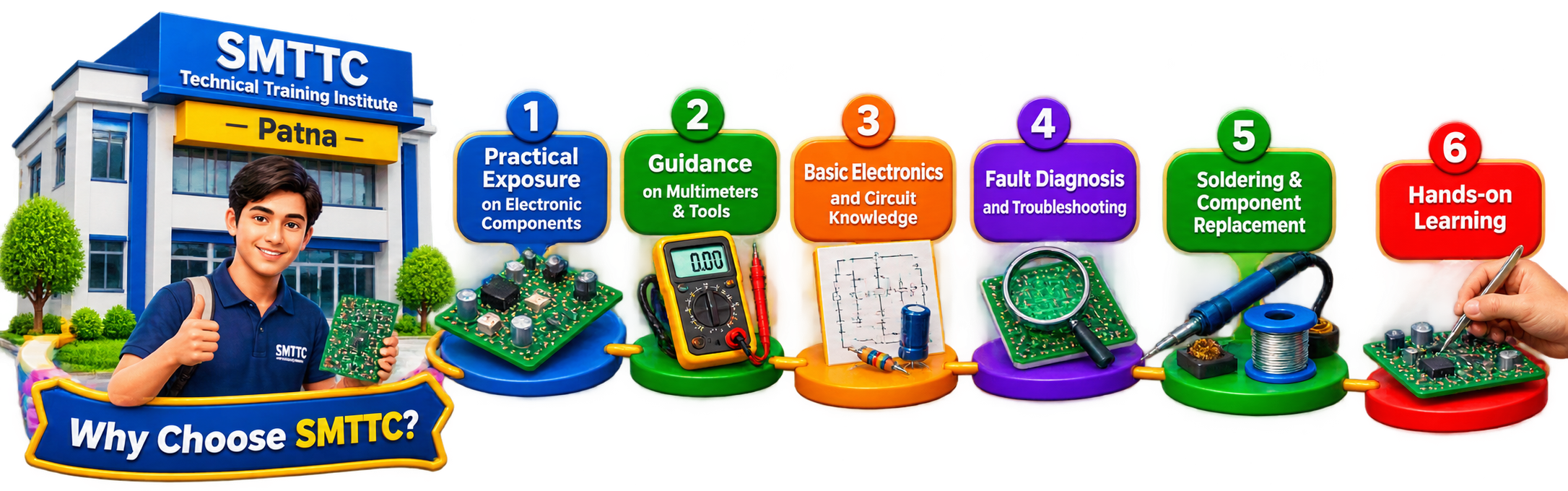
Choosing the right training institute is important when learning a technical skill such as PCB repairing. Students should look for an institute where they can understand electronic components, practise testing methods and develop a systematic approach to fault diagnosis.
At Smart Technical Training Institute (SMTTC), Patna, students can explore technical training programmes designed to develop practical repairing knowledge.
Some important factors to consider when selecting PCB repairing training include:
-
Practical exposure to electronic components and circuit boards
-
Guidance on using multimeters and repairing tools
-
Understanding of basic electronics and circuit connections
-
Training in fault identification and troubleshooting
-
Soldering and component replacement practice
-
Opportunities to improve technical skills through hands-on learning
Before joining, students can contact the institute to confirm the current PCB training syllabus, practical sessions, batch schedule and course details.
PCB Repairing Course Fees, Duration and Training Details at SMTTC
If you are planning to learn PCB repairing in Patna, checking the course duration and fee structure can help you make an informed decision.
Here are the PCB repairing course details provided by SMTTC Institute:
|
Course Detail |
Information |
|---|---|
|
Course Name |
PCB Repairing Course |
|
Institute |
Smart Technical Training Institute (SMTTC) |
|
Location |
Saguna More, Danapur, Patna |
|
Course Duration |
2 Months |
|
Certification |
Yes |
|
Training Focus |
PCB Repairing and Troubleshooting |
Students interested in joining can contact SMTTC Institute to confirm the latest admission schedule, course contents and fee details before enrolment.
Frequently Asked Questions About PCB Repairing Course
1. What is a PCB repairing course?
A PCB repairing course teaches learners how to identify electronic components, understand circuit board connections, test electrical faults and perform basic circuit board repairs.
2. Can beginners learn PCB repairing?
Yes. Beginners can start with basic electronics, component identification, multimeter operation and soldering before moving towards circuit board troubleshooting and repair techniques.
3. How long does it take to learn PCB repairing?
The learning period depends on the course structure and the learner's practical experience. The PCB repairing course listed by SMTTC Institute has a duration of two months.
4. What tools are required for PCB repairing?
Common PCB repair tools include a digital multimeter, soldering iron, hot air rework station, DC power supply, PCB holder, tweezers, flux and solder wire.
5. Is PCB repairing a good career option?
PCB repairing can provide opportunities in electronics service centres, repair workshops and independent servicing businesses. Practical skills and experience are important for developing a career in this field.
6. What is the fee for a PCB repairing course in Patna?
According to the course details provided by SMTTC Institute, the PCB repairing course fee is ₹25,000 for a two-month programme. Students should confirm the latest fee before admission.
7. Where can I learn PCB repairing in Patna?
Students can explore PCB repairing training at Smart Technical Training Institute (SMTTC), located near Saguna More, Danapur, Patna.
8. Can I learn PCB repairing without an electronics background?
Yes. Beginners can learn PCB repairing by starting with basic electrical concepts, electronic components and testing tools. Consistent practical practice helps build understanding.
9. What types of circuit boards can be repaired?
Depending on the technician's knowledge and equipment, different circuit boards used in electronic appliances, power supplies, computers and other devices can be diagnosed and repaired.
10. Is practical training important for PCB repairing?
Yes. Practical training helps learners understand how to use testing tools, identify faulty components, perform soldering and follow a proper troubleshooting process.
Conclusion
PCB repairing involves technical skill which is based on electronics, testing of components and fault diagnosis. Having knowledge about working of circuit boards and faults associated with it will enable one to build a basic knowledge in electronics repairing.
For the students searching for a PCB repairing course in Patna, selecting practical training along with proper guidance is a significant aspect. One can find such practical training through Smart Technical Training Centre (SMTTC), situated near Saguna More, Danapur, Patna.
For those who want to learn troubleshooting of circuit boards and build practical knowledge in electronics, one can go for the PCB repairing course from SMTTC institute and verify the course information and admissions criteria.
Contact Smart Technical Training Institute (SMTTC)

Website: https://smttcinstitute.com