Have you ever seen an AC machine working continuously despite the room being cooled while others switch off their compressors only to restart after a while? Such observations are not really malfunctions of these machines; they are actually due to the technology that has been adopted by the air conditioner.
While considering the differences between inverter AC and non-inverter AC machines, one of the most significant things to observe is the operation of their compressors. Both the machines are created with the intention of cooling a room but they use different techniques for doing so.
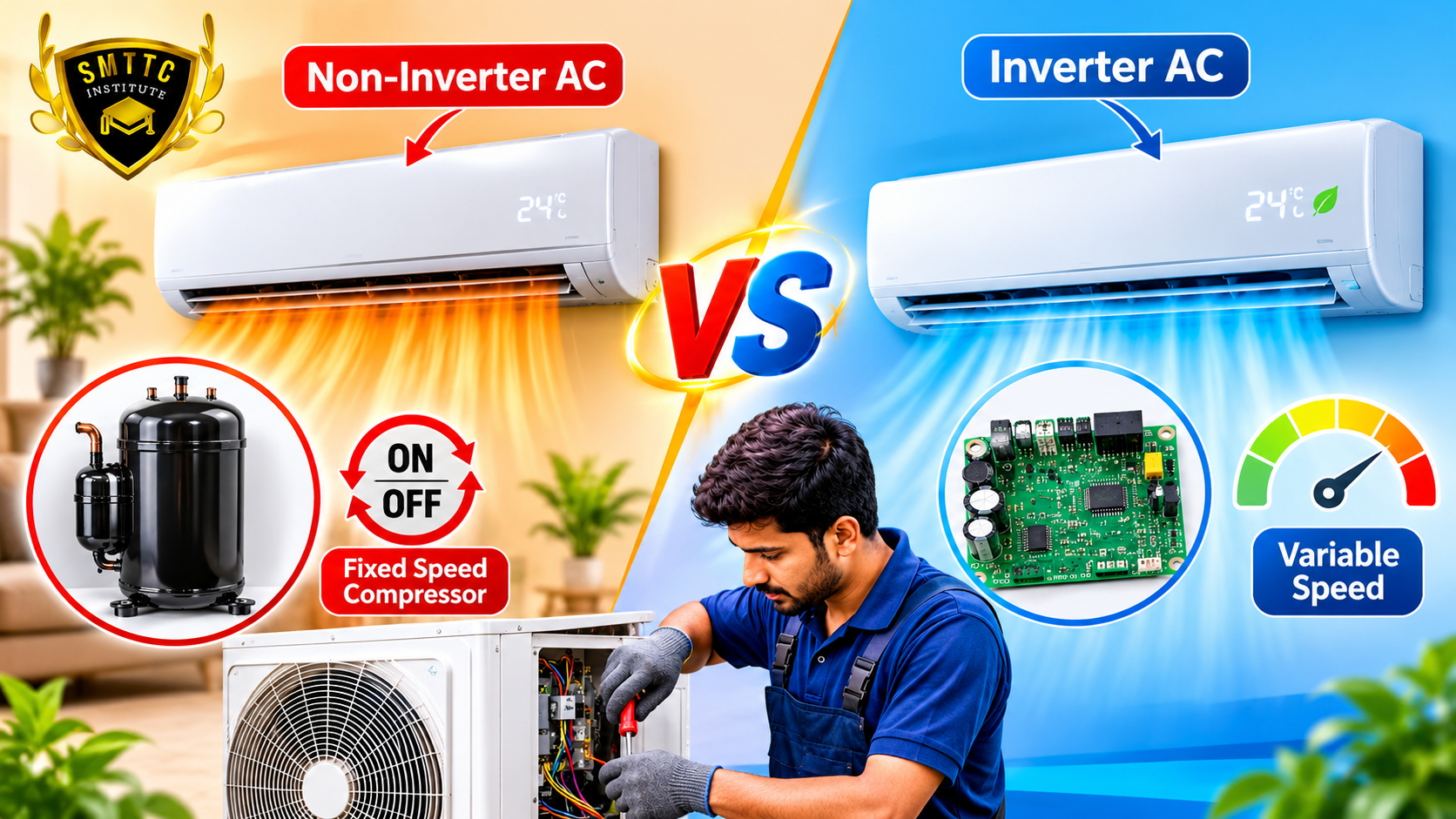
The most important aspect that distinguishes non-inverter AC from inverter AC is the way each system works. The non-inverter AC machine uses its compressor in a constant speed to achieve the cooling while inverter uses a varying speed compressor to perform this task.
Such knowledge could be of great help to any individual who has an interest in the technology of air conditioners.
The Compressor Makes the Biggest Difference
In order to understand inverter ACs and non-inverter ACs, one should start by looking at the compressor rather than the looks or the remote control of the two.
The compressor moves the refrigerant throughout the air conditioning system. This is the component that assists in moving heat from indoors to outdoors. The absence of the compressor would mean no cooling can happen.
Nevertheless, there are differences in how the compressor works in the two cases.
How a Non-Inverter AC Works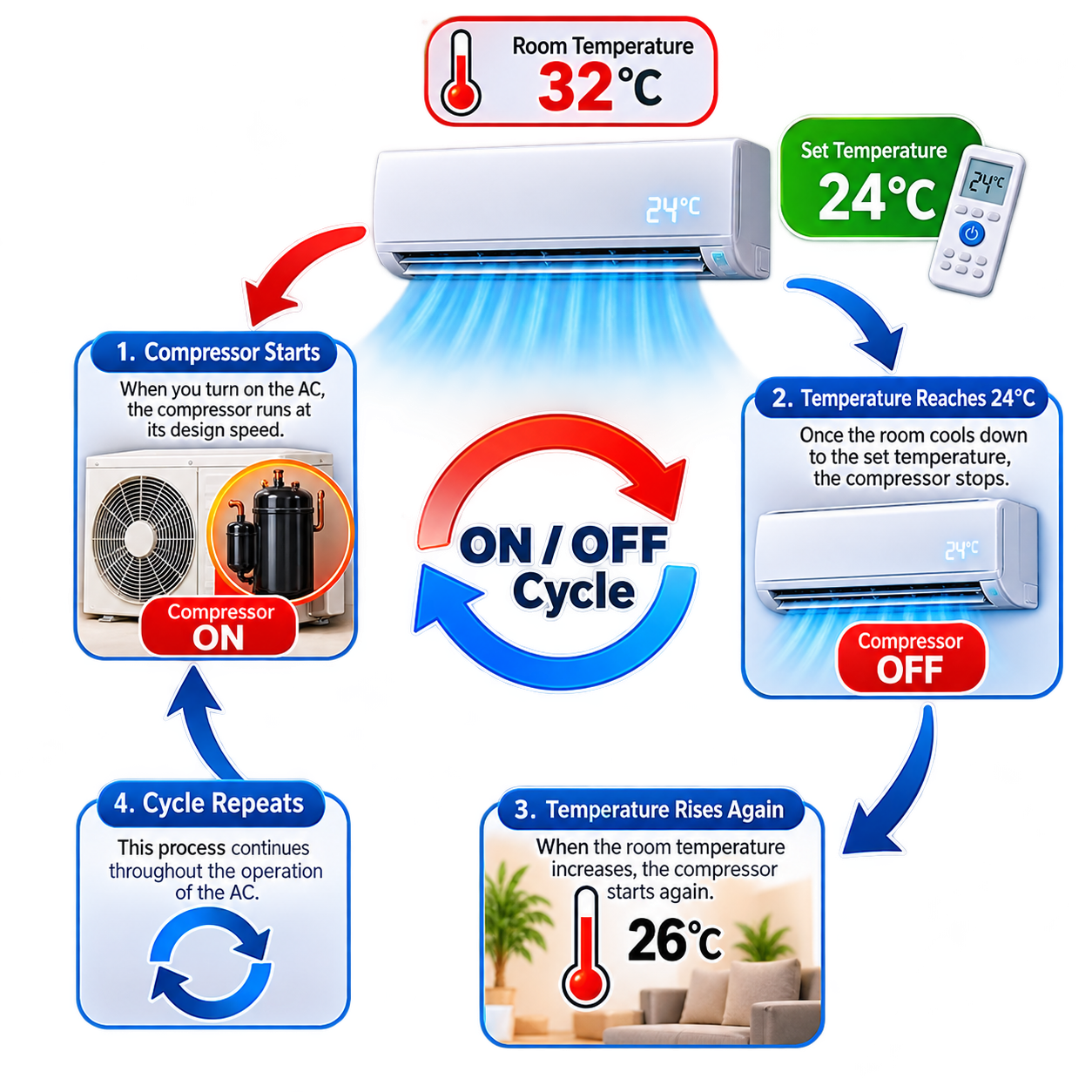
Typically, a traditional non-inverter AC system will use a single-speed compressor. Once you turn on the AC, the compressor will start working at the design speed.
Let's assume that the current temperature in the room is 32°C, and the user wishes to set it to 24°C. The compressor keeps running until the temperature requirement is met.
As soon as the necessary temperature is reached, the control mechanism shuts down the compressor. When the room temperature increases after some time, the compressor starts running again.The cycle is repeated through the operation of the AC.
Perhaps, you can observe such cycles at home. Your indoor unit will keep running the air circulation process, whereas the compressor of the outdoor unit is turned off for a while and starts working again.
How an Inverter AC Works
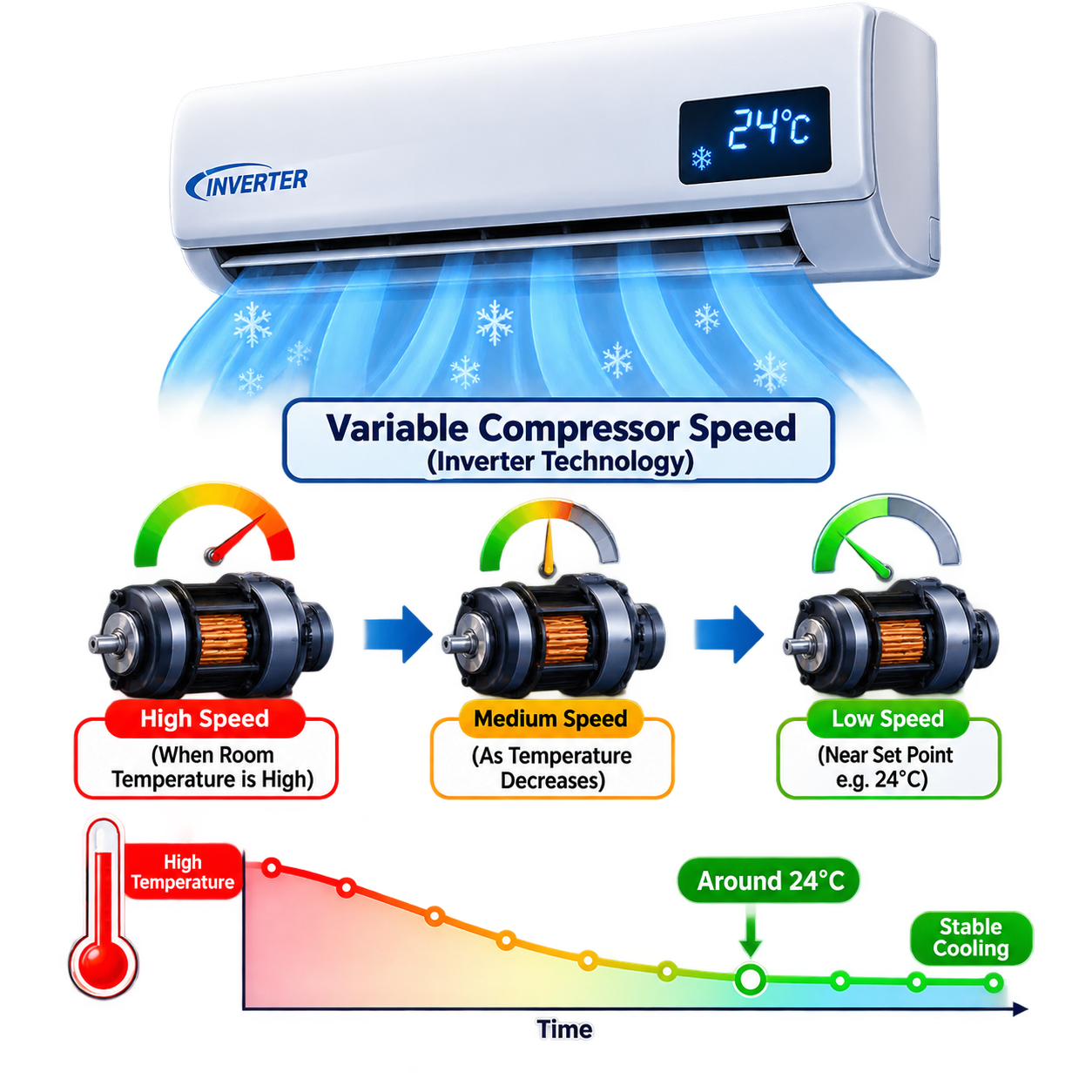
Invertor AC has a different approach to the same amount of cooling requirement.
Unlike fixed ACs that depend on frequent starting and stopping of the compressor, it varies the compressor speed based on the cooling requirements.
If the room temperature is high, the compressor could operate at a higher speed to ensure enough cooling. When the room temperature nears the set point, the speed of the compressor decreases.
For instance, after the room gets to about 24 degrees centigrade, the compressor can still run at a lower speed. The exact procedure depends on the particular model, temperature, and control system used.
The varied speed of the compressor is the major difference between invertor and other regular ACs.
What Happens When the Room Temperature Changes?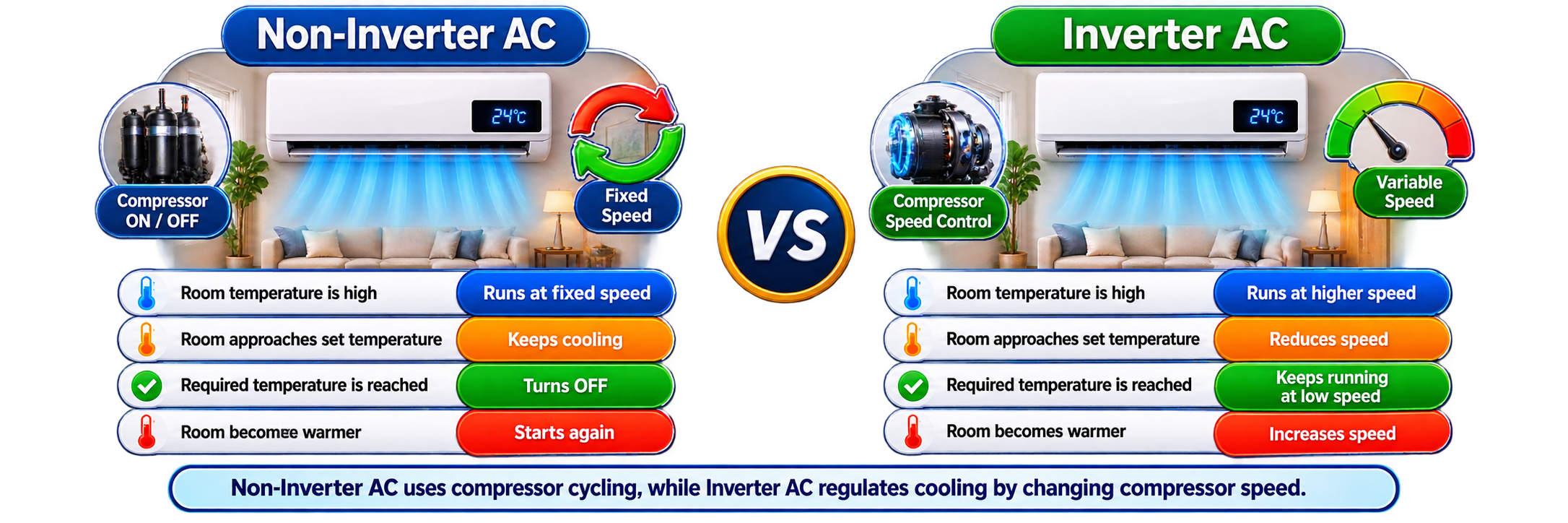
Let us assume that two air conditioners are put into identical rooms. They are turned on simultaneously, and they are both set to 24°C.
At first, both systems have to extract heat from the room. However, the distinction becomes clear once the room temperature approaches the selected one.
|
Operating Condition |
Non-Inverter AC |
Inverter AC |
|
Room temperature is high |
Compressor runs at its fixed operating speed |
Compressor can operate at higher speed |
|
Room approaches the set temperature |
Compressor continues cooling |
Compressor adjusts its speed |
|
Required temperature is reached |
Compressor generally switches off |
Compressor may continue at reduced speed |
|
Room becomes warmer |
Compressor starts again |
Compressor increases its output as needed |
The important point is that a non-inverter AC controls cooling through compressor cycling, whereas an inverter AC can regulate cooling by changing compressor speed.
This difference becomes particularly relevant when an air conditioner operates for several hours.
What Happens Inside an Inverter AC?
The possibility of varying the compressor’s speed is provided by the electronic control system. The inverter AC requires some more electrical and electronic circuitry for controlling the energy supplied to the motor of the compressor.
The knowledge of this simple process will make the whole technology much clearer.
The Role of the Inverter Circuit
In most inverter AC systems, the input AC is first passed through a rectifying circuit that converts the AC input into DC.
The inverter circuit makes use of electronic switches to provide an output of controlled electrical current for driving the motor.
This helps regulate the frequency and speed of the compressor motor depending on the refrigeration needs.
Why Frequency Control Matters
Compressor motor speed is related to the frequency of its electrical supply. By adjusting the operating frequency, the inverter circuit can control how fast the compressor runs.
This is different from a conventional fixed-speed compressor, which generally operates at its designed speed whenever it is switched on.
The Importance of Sensors and PCB
PCB works as a vital controller in the AC inverter. The inverter PCB gets its data from various sensors, and then it regulates the system.
For instance, the data collected from temperature sensors will enable the AC to know how the cooling process is happening. The control unit will use such data to control the compressor.
That explains why inverter PCB is an essential component for technicians who deal with air conditioners.
Why Do Inverter ACs Often Consume Less Electricity?
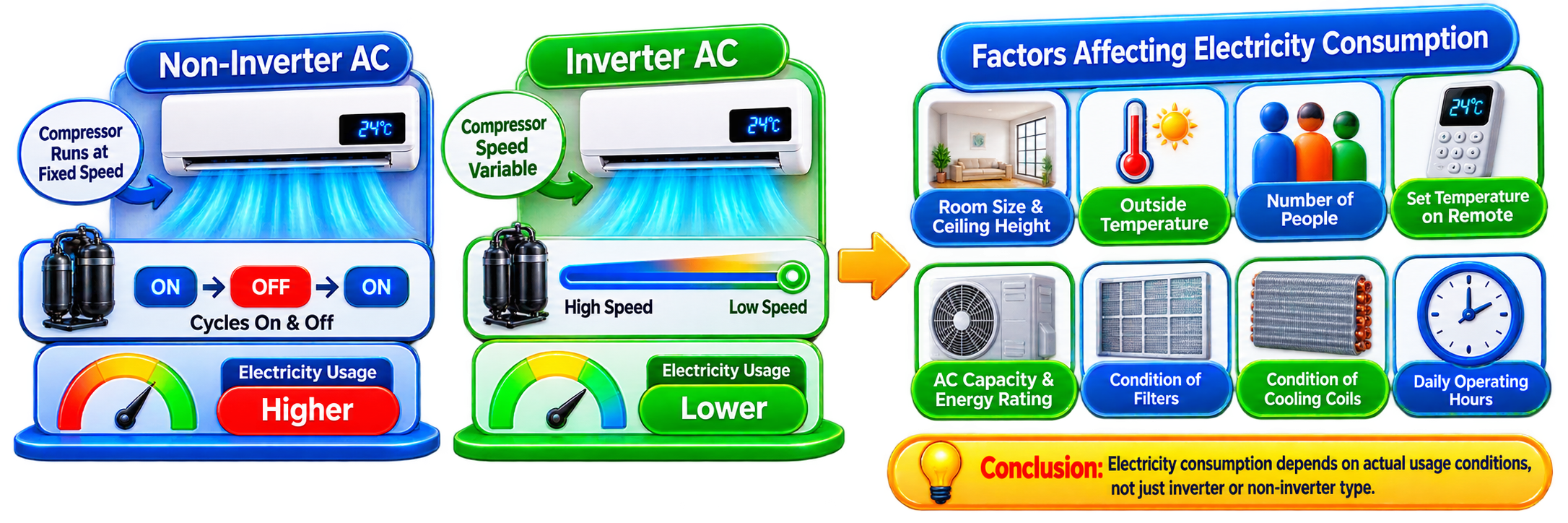
Consumption of electricity is among the major factors which make people compare the two ACs.
A typical AC will be running the compressor at its set speed once it gets started. The compressor turns off when the set temperature is achieved and gets started when more cooling is needed.
The inverter AC reduces the speed of the compressor when less cooling is needed. This means that rather than shutting off and starting the compressor in full operating speed, it can regulate the temperature by operating at low speed.
The difference can help to reduce the electricity used under ideal operating conditions.
But the differences are not the same in all situations.
Direct sunlight, improperly sized AC, dirty filters, or lack of proper insulation in the room can make it need more cooling. And even with all the efficiencies of the inverter AC, it ends up using more electricity.
The following factors also affect electricity consumption:
-
Room size and ceiling height
-
Outside temperature
-
Number of people in the room
-
Temperature selected on the remote
-
AC capacity and energy rating
-
Condition of filters and cooling coils
-
Daily operating hours
Therefore, when comparing inverter AC power consumption vs normal AC, it is important to consider the actual usage conditions instead of assuming that every inverter model will always consume less electricity.
What Is Different Inside the Two AC Systems?
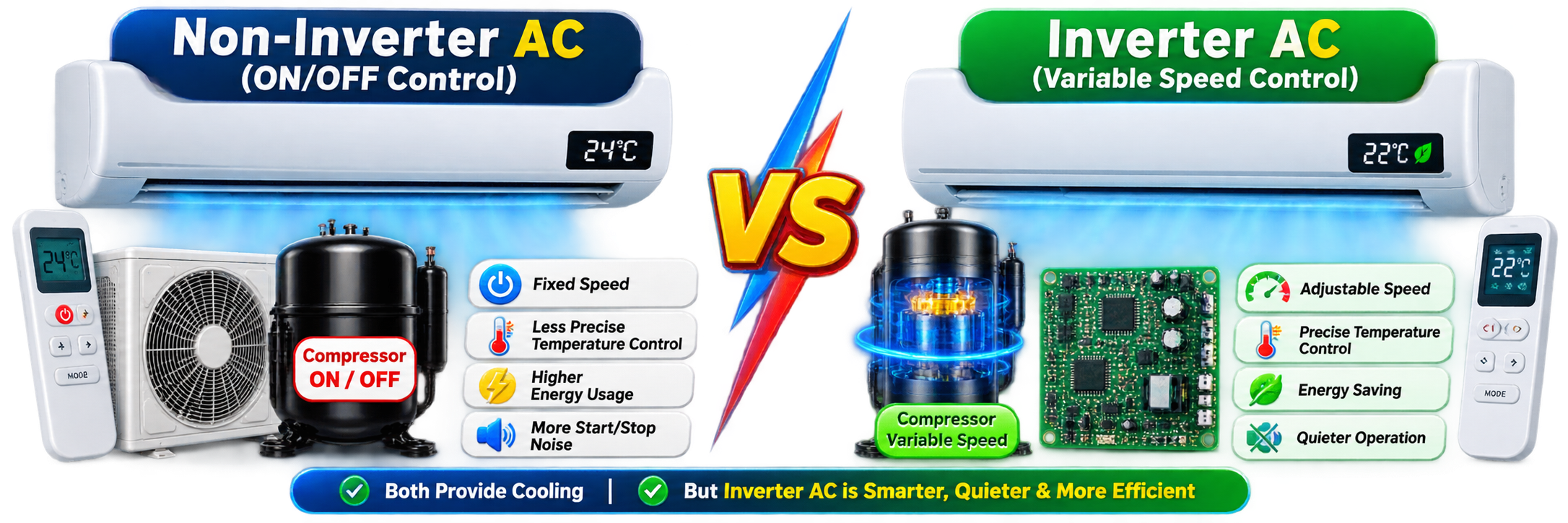
Despite the fact that both operate under the same basic refrigeration process, their electrical control systems are not exactly the same.
A typical air conditioner has an uncomplicated electrical control system for the compressor. This system will vary depending on how the air conditioner was designed. It can be through a capacitor, relay, contactor, or others.
Inverters have extra electronic controls for controlling the speed of the compressor and the motor.
Below is a comparison:
|
Component |
Non-Inverter AC |
Inverter AC |
|
Compressor |
Fixed-speed operation |
Variable-speed operation |
|
Control system |
Conventional switching arrangement |
Electronic inverter control |
|
PCB |
Basic system control, depending on model |
Advanced compressor and system control |
|
Sensors |
Used for temperature and protection functions |
Provide feedback for variable operation |
|
Electrical circuit |
Conventional compressor control |
Includes inverter drive electronics |
This difference is particularly important from a repairing point of view. A technician cannot assume that the electrical testing method used on a conventional AC will apply to every inverter model.
What Kind of Problems Can Occur in These ACs?
There are several causes that may lead to an air conditioner ceasing its operations. The compressor is not the only component of the air conditioning system, and thus one would incur unnecessary costs by replacing it without prior analysis.
The problems found in traditional and inverter air conditioners may also vary since their electric configurations are different.
Common Non-Inverter AC Problems
A technician working on a conventional AC may come across:
-
Faulty compressor capacitor
-
Compressor not starting
-
Loose or damaged electrical connections
-
Faulty relay or contactor, where fitted
-
Indoor or outdoor fan motor problems
-
Thermostat or sensor faults
-
Refrigerant leakage
For example, if the compressor is not starting, a technician may first check the incoming power supply, wiring, capacitor where applicable and compressor electrical condition. The exact checks depend on the compressor design.
Common Inverter AC Problems
Inverter ACs may develop faults related to their electronic control systems, such as:
-
Inverter PCB problems
-
Sensor-related faults
-
Communication errors
-
Power supply abnormalities
-
Inverter drive circuit faults
-
Compressor or motor-related problems
Sometimes the AC displays an error code when a problem is detected. However, an error code should not be treated as automatic proof that a particular component has failed.
A technician needs to check the manufacturer's service information and follow the correct diagnostic procedure before replacing any part.
Why Is Repairing an Inverter AC Different?
The principles of refrigeration stay the same, however, electrical diagnosis requires a new level of expertise.
Let’s say you have a regular AC compressor that won’t start. For one system you might want to check the capacitor, supply voltage, connections, and compressor.
Imagine now that you are dealing with an inverter AC which has a problem with the compressor. That problem can come from inverter PCB, power supply, communication circuit, sensor or the compressor.
What you see here is that for such diagnosis one needs to know more than just basics about electrical wiring and replacements.
Circuit schematics, multimeter usage, electronic parts, and inverter technology all become useful while diagnosing these systems.
One needs to remember that there can be high DC voltages in inverter AC circuits even if the power supply has been disconnected. Isolation, discharge and proper testing equipment are important. Such tests can be done by people who have the necessary technical knowledge.
Which One Should You Choose?
Choosing the appropriate one would depend on the way it would be used.
The inverter air conditioner could possibly be chosen if cooling is needed for a few hours each day in one's house. The ability to control the compressor speed would make it possible to keep the room at a constant temperature, thus increasing efficiency.
It could be selected even in case the initial cost is constrained or usage is expected to be relatively short.
Prior to buying any of them, one should pay attention to such factors as AC capacity, its energy class, warranty and maintenance services, as well as the number of operating hours.
The purchase cost is not indicative of the economy of air conditioning system operation.
Why Should Future AC Technicians Understand Both Technologies?
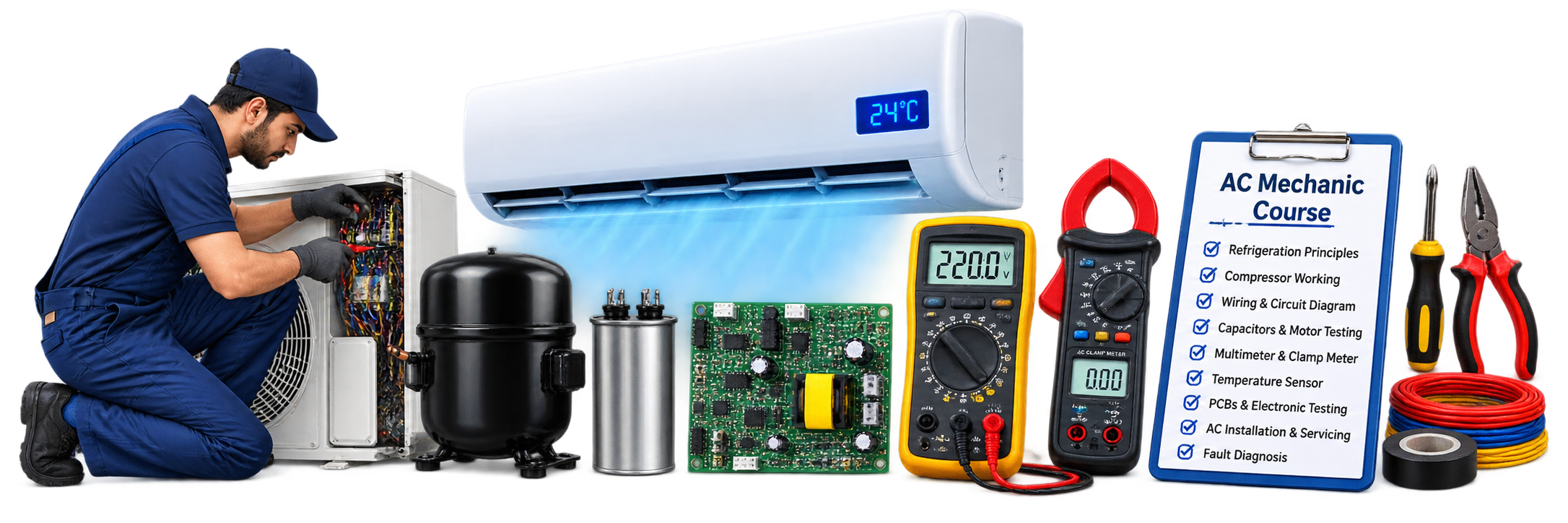
AC service jobs do not end at cleaning the filters and topping up the refrigerant. The job requires one to identify the reason behind the machine failing to cool or start its compressor and which part might be causing the fault.
Electronic Control has become very important for AC servicing due to the latest inverter ACs.
Some one choosing to study this field should learn slowly about:
-
How a compressor works and refrigeration principles
-
Wiring and Circuit Diagram
-
Capacitors and Motor Testing
-
Usage of Multimeter and Clamp Meter
-
Temperature Sensor and Control system
-
PCBs and their basic electronic testing
-
AC Installation and Servicing
-
Fault Diagnosis
When it comes to selection of an AC training center, a beginner should think beyond the course title and see whether they get some practical training in electronic testing and the components of AC.
AC training courses having practical tests and some theoretical information will enable the trainees to know how these systems operate rather than just learning the names of components.
For students wanting to enroll themselves in an AC Mechanic Course in Patna, it would be advisable to first know about the course duration, practical training, equipment and topics covered.
Learn AC Repairing at Smart Technical Training Institute (SMTTC), Patna
Distinguishing the differences between conventional ACs and inverters is just one of the many factors that help develop the skills needed to be an AC technician.
Students who wish to learn AC repairs can take advantage of the training offered at Smart Technical Training College (SMTTC) which covers various aspects of AC repairs.
Prior to enrolling in any courses, the students can see the training available and how long it takes.
Explore the AC Repairing Course: https://smttcinstitute.com/courses/ac-repairing
Final Thoughts
Both invertor AC and non-invertor AC might have the same cooling function, but their operations differ greatly. The most obvious difference is in the control of compressors, where one uses the ON/OFF function, while another adjusts its speed depending on the cooling needed.In regard to users, it will help understand differences in the control of temperatures and energy usage. In regard to someone wishing to repair, it is a way to see the importance of knowing electrical circuits and electronic systems in the modern day AC servicing.

Knowledge of both systems makes it easy for a novice to understand how AC work